
This is Part 1 of my 4-part series: Navigating The Stages of Growth. [View the Full Series Roadmap]
When I was getting my MBA, it seemed that nearly every class presented at least one theoretical model. The one that has really stood out to me throughout my career—from my time in consulting to leading three teams at Google—is Tuckman’s Model of Team Performance. I have seen this model play out hundreds of times. As a tech lead in the consulting industry for many years, I frequently had to quickly pull teams together. I feel like I have a rare glimpse into managing team dynamics especially after coupling my consulting experience with the three teams I led at Google and beyond. Team building is my superpower.
I believe that understanding this model gives you a rare glimpse into the “messy, beautiful” reality of team building. It’s a natural progression, similar to a learning curve, and it should be expected rather than feared. I’ll touch on this in a later post in the series but it’s a very powerful tool when teams are aware of this model and understand what stage they’re in.
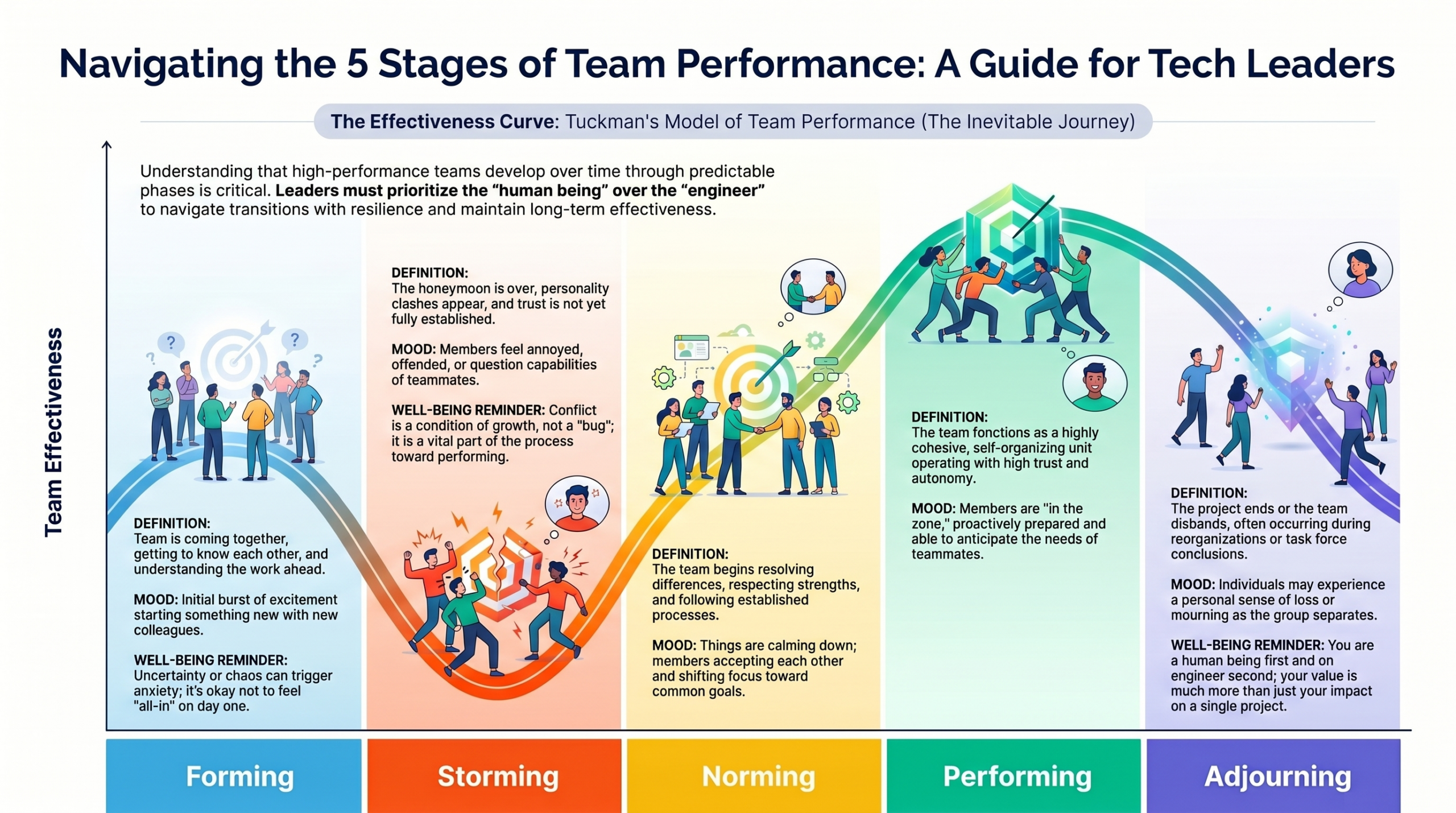
The 5 Stages of a High-Performing Team
We’ll walk through the five stages in the model. I have added callouts for the type of leadership that is generally required at each stage to boost the team.
- Forming
- The Definition: This is when the team is first coming together. It’s a group of individuals still trying to get to know each other and the work ahead.
- The Mood: Most folks feel an initial burst of excitement about starting something new and working with fresh faces.
Well-Being Reminder
While many feel “all-in” on day one, the “uncertainty of the job market” or the “general chaos” of new beginnings can trigger anxiety for some.. If you aren’t feeling the hype immediately, it’s okay—growth is a process.
- Leadership Required: Be mindful that some team members are naturally resistant to change and may find this phase unsettling. Your job is to provide clear direction and establish the basic structures and processes that help people build relationships while moving the ball forward.
- Storming
- The Definition: The “honeymoon phase” is over. Personality clashes may appear as members become more opinionated and question decisions and test the boundaries of their autonomy. Trust and psychological safety are not yet fully established in aggregate across the team.
- The Mood: You might start to feel annoyed, offended, or even question the capabilities of your teammates.
Well-Being Reminder
The Storming phase can feel like a “failure,” but it’s actually a vital part of the process.
Also, sometimes leads may feel the weight of team conflict “sitting right on your chest,” take a deep breath. It’s not a bug in your leadership; it’s a condition of growth. - Leadership Required: It is on you to help move the team toward Norming. You must transform conflict into constructive dialogue, creating a safe space for productive disagreement.
- Norming
- The Definition: The team begins to resolve differences, appreciate each person’s unique strengths, and respect the team’s authority and processes.
- The Mood: Things are calming down. People are accepting each other and focusing collectively on a common goal. Initial processes and workflows are starting to feel appropriate.
- Leadership Required: This is the time to “take your foot off the gas” and let the team drive. Empower them to experiment with their workflows—this is the fertile ground that leads to high performance.
- Performing
- The Definition: The team becomes a highly cohesive, self-organizing unit. There is a high degree of trust, and the team can operate autonomously with little supervision.
- The Mood: Folks are “in the zone”. You can anticipate what your teammates need and show up proactively prepared.
- Leadership Required: Step back and become a supportive observer. Your role is to sustain momentum and support the team as needed, having ideally delegated most aspects of the day-to-day work to its members.
- Adjourning (or Mourning)
- The Definition: The project ends, or the team is disbanded. In the tech world, this may take the form of a re-org or a project sunset.
- The Mood: This is deeply personal. You might feel a sense of loss or “mourning” after completing objectives and separating from the group. Or you might feel excited that the project has finished and launched.
Well-Being Reminder
We are human beings first, and engineers second. For those resistant to change, “adjourning” can feel like losing a support system. Remember that your value is not just your “impact” on a single project, but who you are as a teammate.
- Leadership Required: Teams need celebratory moments. Provide closure through reflection on learnings, celebration of achievements, and clear transition paths for every team member.

Model Progression
Teams/relationships tend to progress linearly from left to right on the model. And, in my experience, it’s possible to skip some stages. Although that’s pretty rare based on what I’ve seen in practice. It’s important to note that any change can pull the team back. What kind of change? Adding a new team member, changing scope, moving seating, someone going from fully in-person to remote, etc. The list is likely endless but its important to notice if we slip back into storming. And, if/when that does happen, you can use the tools I mention in a subsequent post to get the team out of storming.
Are you a leader who is frustrated with your new team? Or tackling a new project? Let’s chat. We’ll talk through this model in more detail and brainstorm ways that you can use it to start a discussion with your team and super charge your team effectiveness.

I've spent over 25 years navigating the software engineering landscape—scaling teams, fostering well-being, and mentoring the next generation of technical leaders. After 6.5 years at Google, I built a coaching practice to help talented engineers and techies unlock their potential and build the momentum that transforms careers. I'm the coach who meets you at your pivotal moments and helps you make the most of them.