
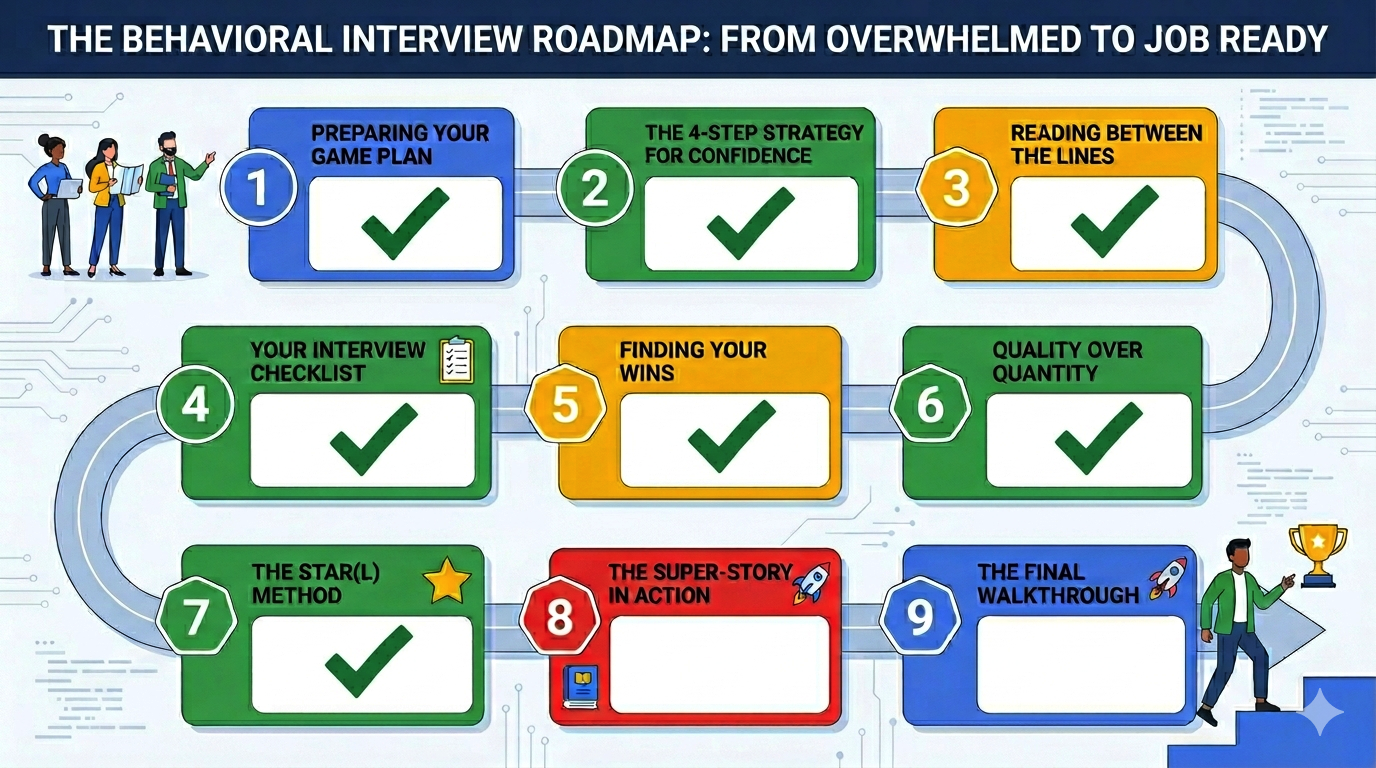
This is Part 7 of my 9-part series: The Behavioral Interview Game Plan. [View the Full Series Roadmap]
When you’re in the middle of an interview, it’s easy for a story to wander. You might start with a great technical detail but forget to mention the outcome. To help you stay on track and feel confident, I recommend using the STAR(L) method.
It’s a simple framework to ensure your stories are clear, concise, and impactful:
- S (Situation): Set the stage.
- T (Task): What was the goal?
- A (Action): What specific steps did you take?
- R (Result): What was the outcome? What metrics can you share?
- L (Learning): What did you take away for the future? What would you do differently?
The “L” is my favorite part—it’s where you show your growth mindset and leadership potential. Let’s look at two ways to build a story using our iOS developer examples.

AI Polish
I can see two compelling use cases for AI here.
- Polish the language and framing, or
- if you’re struggling to mold your past experience into a STAR(L) story.

AI Reality Check
Pay special attention to R and L. Hallucinations can turn polish into poison if its gets these wrong.
Best Practices
General rules of thumb that I’ve developed:
- The 60 Second Rule. Walk through ST in 60 seconds. Tell me what the goal (S) was, what the roadblock (T) was, and stop there.”

Hiring Manager Perspective
Something I frequently see is that candidates start out strong, then seem to get lost and start rambling or meandering. They’re sharing somewhat related details but as a listener, it’s hard to follow. Practice with the 60 Second Rule to ensure you stay on target.
Examples
Demonstrating Ownership (App Maintenance)
Scenario: Preparing to build the Dynamic Island content
- S: When Apple announced the Dynamic Island for the iPhone 14, our team wanted to be early adopters to drive user excitement and adoption.
- T: I was responsible for image processing notifications, so I was tasked with replacing our standard “Upload Completed” alerts with a new Live Activity that showed a real-time progress indicator.
- A: I built out the feature by closely following the new iOS guidelines and ensuring the implementation was robust.
- R: We hit the launch date, and saw our Live Activity usage grow steadily as users embraced the new UI.
- L: Because Apple updates iOS yearly, I realized we needed to be more proactive. We now prioritize WWDC content and developer betas earlier in the year to give us more time to innovate.
Demonstrating Partnership (Collaboration)
Scenario: Partnered with UX and product manager to build out the Dynamic Island content.
- S: Our team prioritized updating our infrastructure to take advantage of the latest iOS features.
- T: We needed to quickly align on product requirements and user experience goals.
- A: I took the lead in partnering cross-functionally with our Product Manager and UX Designer.
- R: By being a stakeholder early on, I was able to suggest minor UX tweaks that reduced our development time from 3 months to just 3 weeks. This allowed us to be live on day one of the iOS release.
- L: This experience showed me the value of shared long-term goals. My PM, UX lead, and I now meet regularly to stay strategically aligned so we’re always moving in the same direction.
The EM Perspective: At companies like Google, a positive “Result” is often the baseline. The “Learning” is what demonstrates that you have the growth mindset and leadership qualities they are looking for.
What’s Next?
These are great individual stories, but remember how we talked about “Super-Stories”? In our next post, I’ll show you how to blend these two examples into one high-impact narrative that shows off your technical skills and your collaboration skills at the same time.
If you want to practice your own STAR(L) stories and get real-time feedback, let’s chat. I offer behavioral interview coaching for tech to help you tell your story with total confidence.

I've spent over 25 years navigating the software engineering landscape—scaling teams, fostering well-being, and mentoring the next generation of technical leaders. After 6.5 years at Google, I built a coaching practice to help talented engineers and techies unlock their potential and build the momentum that transforms careers. I'm the coach who meets you at your pivotal moments and helps you make the most of them.