
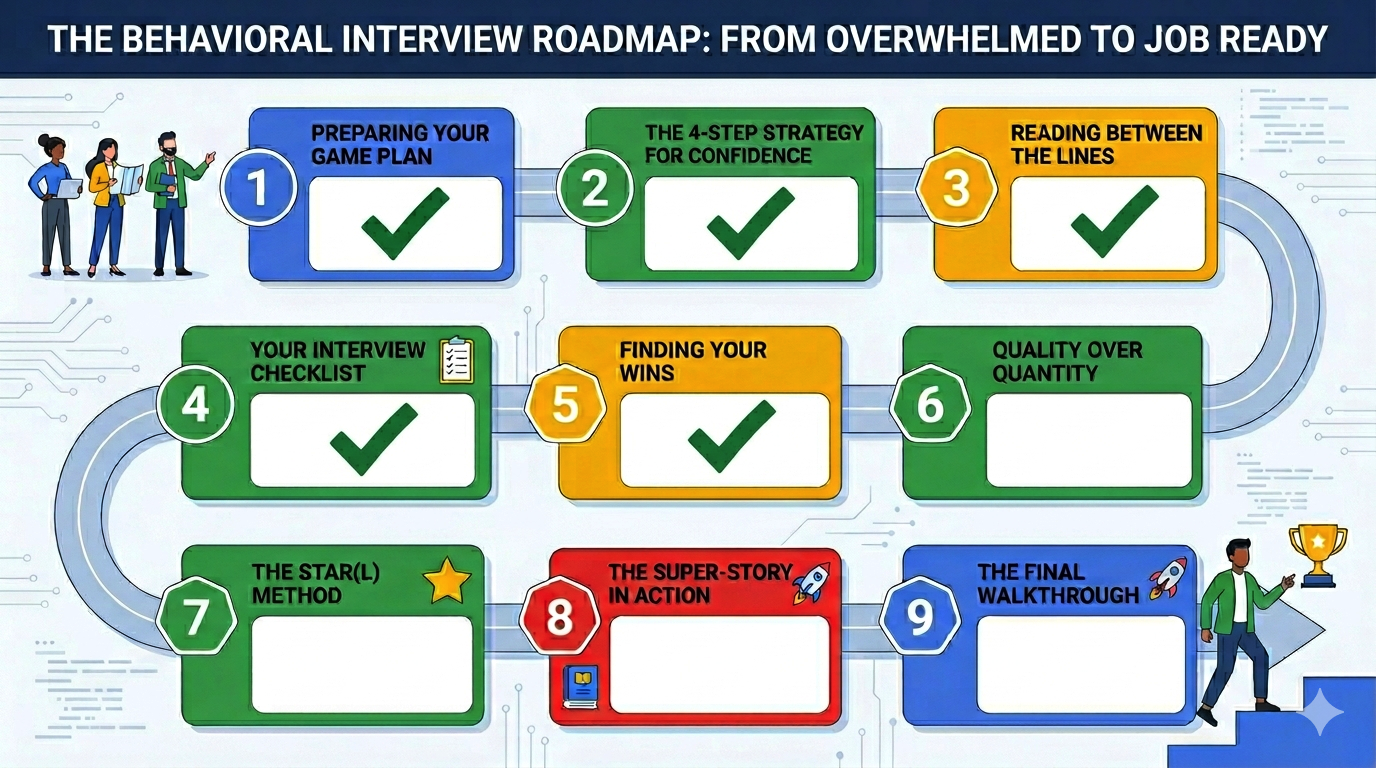
This is Part 5 of my 9-part series: The Behavioral Interview Game Plan. [View the Full Series Roadmap]
Now we get to the heart of our preparation: finding your stories. Sometimes, when we’re asked to talk about our past work, our minds go blank. We think, “I was just doing my job—was that really a ‘scenario’?” My advice? Yes, it was! Every bug you fixed and every collaboration with a designer is a “win” that demonstrates your value.
Our goal now is to look at our success checklist from the previous post and find a specific time in your career where you demonstrated that quality. To keep things manageable, we’ll just walk through a few examples together to show you how it’s done.
Your Experience Inventory
f
| The Attrribute We Want to Show | A “Win” From Your Past |
| App Maintenance | I updated our photo notifications to support the Dynamic Island. |
| Bug Resolution | I solved a high-priority production bug where images with spaces in their names weren’t displaying. |
| Clean Code | I DRY’d out the code and refactored our image-sorting logic. |
| Cross-Functional Collaboration | I partnered closely with our UX designer and Product Manager to define the Dynamic Island content. |
| Debugged Code | Debugged issue in production build where spaces caused images to disappear from the image selection screen. |
| Efficient Code | I reduced the complexity (Big O) of sorting algorithms. |
| Focus On Quality | Took the time to refactor WET code to increases test coverage and fix a production issue. |
| Individual Ownership | I took the lead on writing the technical design for our new SwiftUI image selection screen. |
| Interface Builder | [Hypothetical] Coming up to speed on legacy XIB implementation of the image upload screen.
READER NOTE: Before using a hypothetical, read my thoughts below. |
| iOS Best Practices | I advocated for switching to SVG assets to ensure our UI stayed crisp on all devices. |

Well-Being Reminder
If your mind is going blank or you are struggling to find your gold, this might be imposter syndrome at work. For more on quieting that voice and finding grounding, visit my mental health support series.
A Quick Note on “Hypotheticals”
If you’re early in your career and a specific quality doesn’t have a matching story yet, don’t worry. You can prepare a “hypothetical” answer. For example, if you haven’t used legacy XIBs before, you might explain your process for how you would come up to speed on them.
Pro-Tip: Always prioritize real stories first. We use hypotheticals as a last resort to show your thought process and how you approach new challenges. Your real-world experience is your greatest asset!

AI Polish
Before using a hypothetical story, work with your favorite LLM to see if it can sniff out a win for particular attribute(s) from your experiences.
Still not finding anything? Let’s chat so we can fine tune your AI exploration before resorting to a hypothetical.

AI Reality Check
As always, when using AI, be sure that the resultant details are valid and not hallucinated. The story should ring true.
As a realty check, do the former lead check. If you were telling your former skip level this story, would they agree with you? Or would they call BS? If the later, don’t use it.
What’s Next?
Once you’ve gone through your own full checklist and jotted down these brief notes, you’re ready for the next level. In our next post, we’re going to take these “wins” and turn them into structured, powerful STAR(L) stories that will truly impress your interviewer.
Finding the right stories can be tough to do alone. If you’re struggling to identify your “wins,” let’s chat. My behavioral interview coaching for tech is designed to help you see the incredible value in your own experience.

I've spent over 25 years navigating the software engineering landscape—scaling teams, fostering well-being, and mentoring the next generation of technical leaders. After 6.5 years at Google, I built a coaching practice to help talented engineers and techies unlock their potential and build the momentum that transforms careers. I'm the coach who meets you at your pivotal moments and helps you make the most of them.